Sample pages
Two real dictionary entries from the 131-symbol system, and a short excerpt from the chapter on the science behind it. This is exactly what's inside the book.
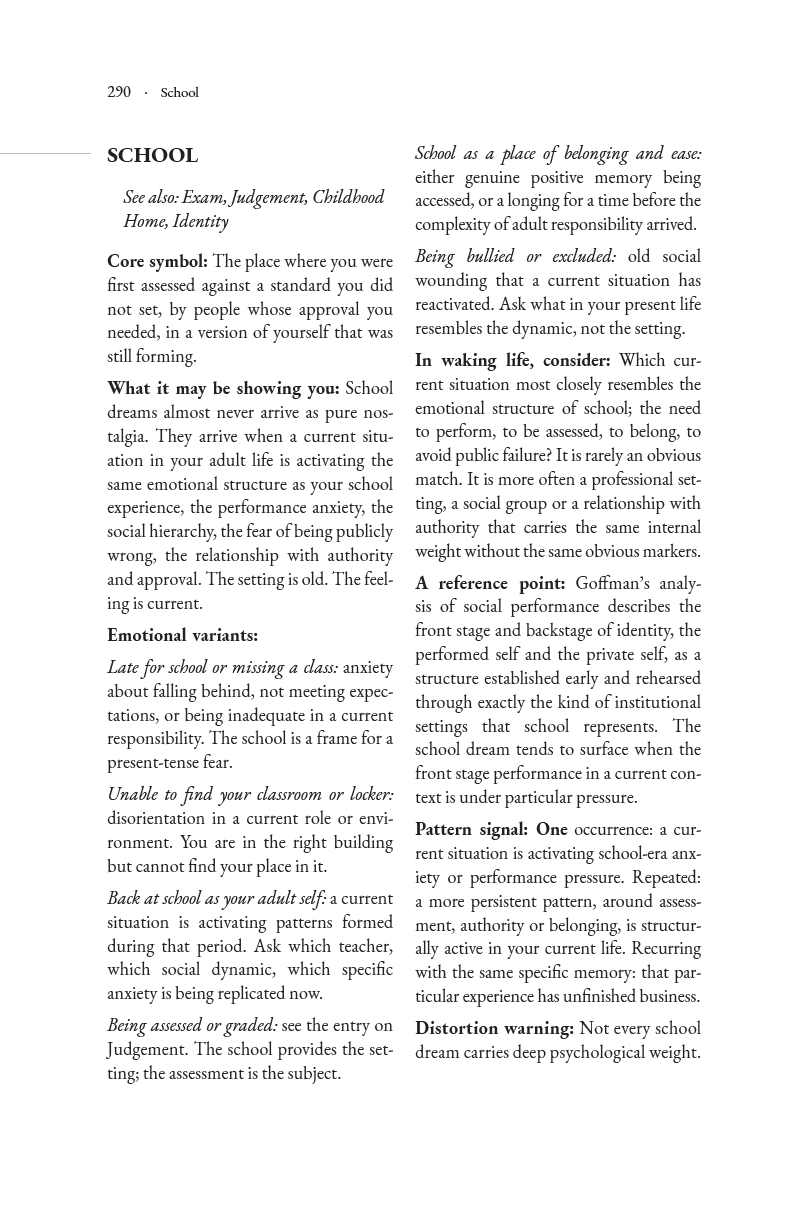
From the dictionaryThe place where you were first assessed against a standard you did not set, by people whose approval you needed, in a version of yourself that was still forming.
School dreams almost never arrive as pure nostalgia. They arrive when a current situation in your adult life is activating the same emotional structure as your school experience, the performance anxiety, the social hierarchy, the fear of being publicly wrong, the relationship with authority and approval. The setting is old. The feeling is current.
Late for school or missing a class: anxiety about falling behind, not meeting expectations, or being inadequate in a current responsibility. The school is a frame for a present-tense fear.
Unable to find your classroom or locker: disorientation in a current role or environment. You are in the right building but cannot find your place in it.
Back at school as your adult self: a current situation is activating patterns formed during that period. Ask which teacher, which social dynamic, which specific anxiety is being replicated now.
School as a place of belonging and ease: either genuine positive memory being accessed, or a longing for a time before the complexity of adult responsibility arrived.
Which current situation most closely resembles the emotional structure of school, the need to perform, to be assessed, to belong, to avoid public failure? It is rarely an obvious match. It is more often a professional setting, a social group or a relationship with authority that carries the same internal weight without the same obvious markers.
Goffman's analysis of social performance describes the front stage and backstage of identity, the performed self and the private self, as a structure established early and rehearsed through exactly the kind of institutional settings that school represents. The school dream tends to surface when the front stage performance in a current context is under particular pressure.
One occurrence: a current situation is activating school-era anxiety or performance pressure. Repeated: a more persistent pattern, around assessment, authority or belonging, is structurally active in your current life. Recurring with the same specific memory: that particular experience has unfinished business.
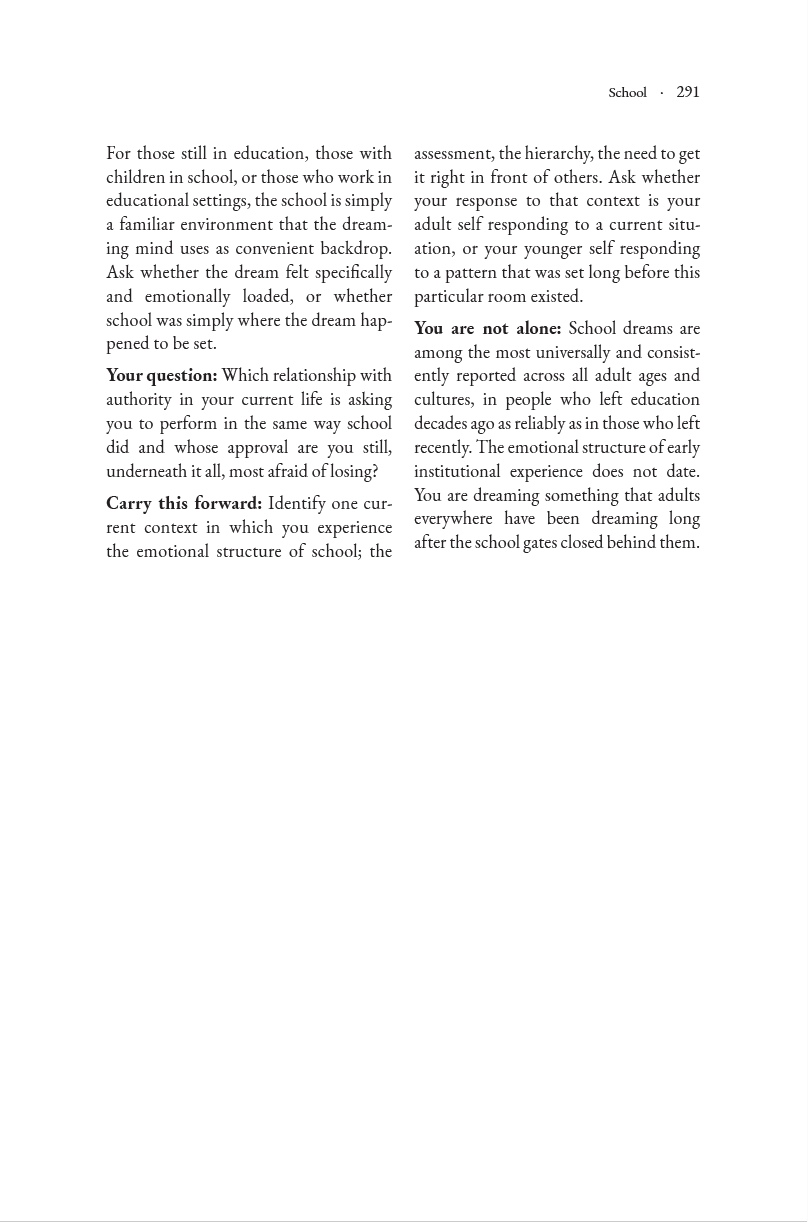
Not every school dream carries deep psychological weight. For those still in education, those with children in school, or those who work in educational settings, the school is simply a familiar environment that the dreaming mind uses as convenient backdrop. Ask whether the dream felt specifically and emotionally loaded, or whether school was simply where the dream happened to be set.
Which relationship with authority in your current life is asking you to perform in the same way school did, and whose approval are you still, underneath it all, most afraid of losing?
Identify one current context in which you experience the emotional structure of school, the assessment, the hierarchy, the need to get it right in front of others. Ask whether your response to that context is your adult self responding to a current situation, or your younger self responding to a pattern that was set long before this particular room existed.
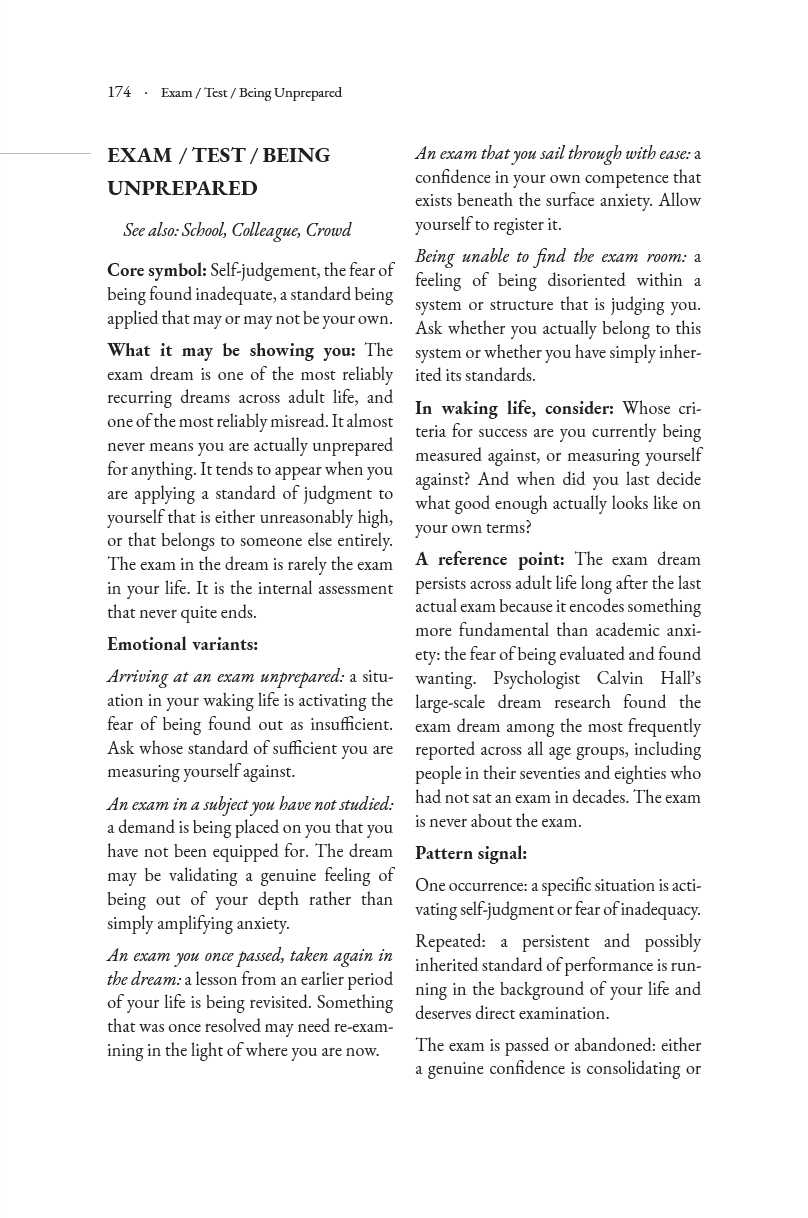
Something once resolved, needing re-examining: a matter you believed settled may need revisiting in light of where you are now.
An exam you sail through with ease: a confidence in your own competence that exists beneath the surface anxiety. Allow yourself to register it.
Unable to find the exam room: a feeling of being disoriented within a system or structure that is judging you. Ask whether you actually belong to this system or whether you have simply inherited its standards.
Whose criteria for success are you currently being measured against, or measuring yourself against? And when did you last decide what good enough actually looks like on your own terms?
The exam dream persists across adult life long after the last actual exam because it encodes something more fundamental than academic anxiety, the fear of being evaluated and found wanting. Psychologist Calvin Hall's large-scale dream research found the exam dream among the most frequently reported across all age groups, including people in their seventies and eighties who had not sat an exam in decades. The exam is never about the exam.
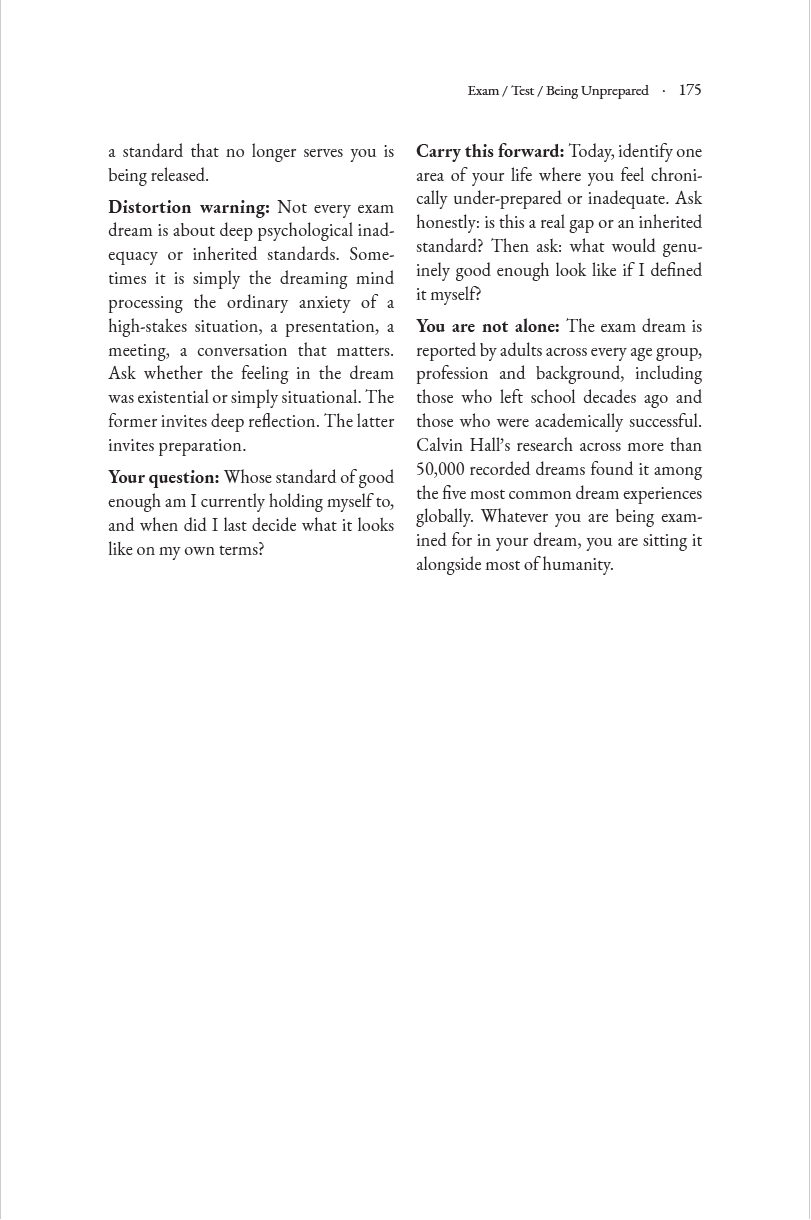
One occurrence: a specific situation is activating self-judgment or fear of inadequacy. Repeated: a persistent and possibly inherited standard of performance is running in the background of your life and deserves direct examination. The exam is passed or abandoned: either a genuine confidence is consolidating or a standard that no longer serves you is being released.
Not every exam dream is about deep psychological inadequacy or inherited standards. Sometimes it is simply the dreaming mind processing the ordinary anxiety of a high-stakes situation, a presentation, a meeting, a conversation that matters. Ask whether the feeling in the dream was existential or simply situational. The former invites deep reflection. The latter invites preparation.
Whose standard of good enough am I currently holding myself to, and when did I last decide what it looks like on my own terms?
Today, identify one area of your life where you feel chronically under-prepared or inadequate. Ask honestly: is this a real gap or an inherited standard? Then ask: what would genuinely good enough look like if I defined it myself?
The exam dream is reported by adults across every age group, profession and background, including those who left school decades ago and those who were academically successful. Calvin Hall's research across more than 50,000 recorded dreams found it among the five most common dream experiences globally. Whatever you are being examined for in your dream, you are sitting it alongside most of humanity.
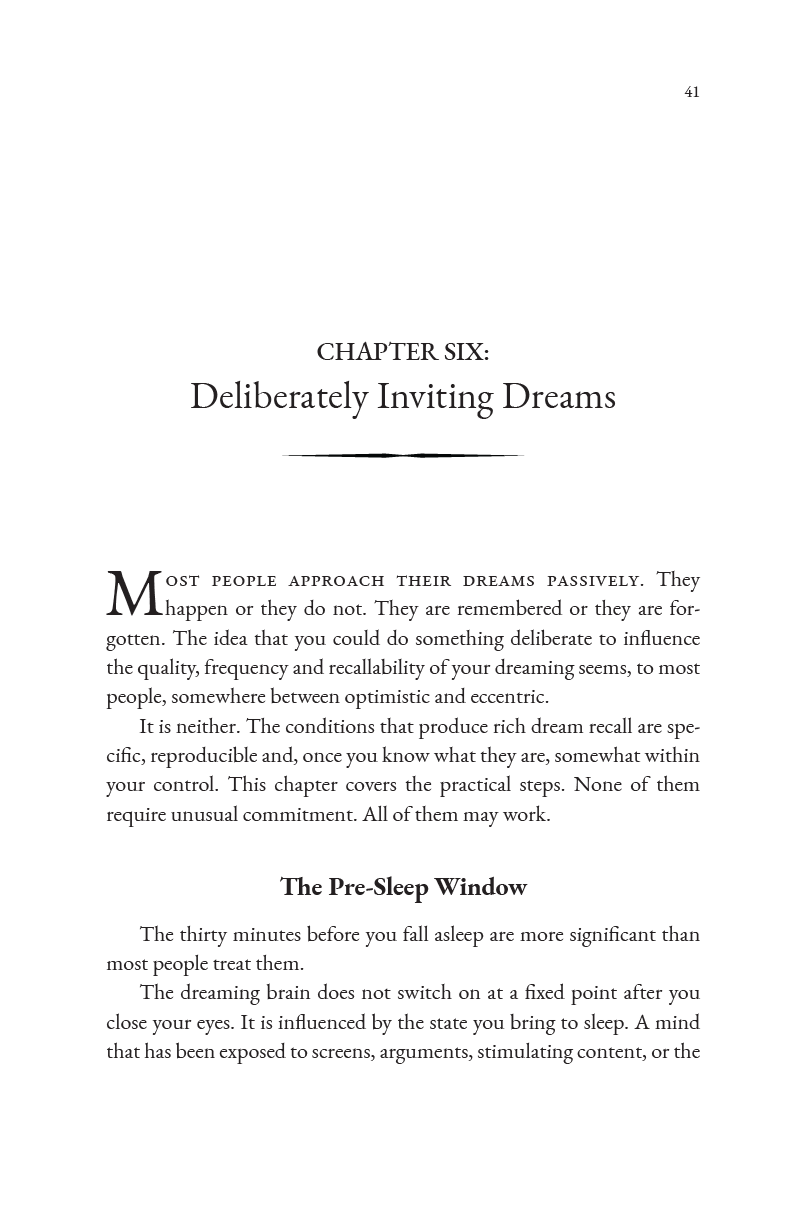
Most people approach their dreams passively. They happen or they do not. They are remembered or they are forgotten. The idea that you could do something deliberate to influence the quality, frequency and recallability of your dreaming seems, to most people, somewhere between optimistic and eccentric.
It is neither. The conditions that produce rich dream recall are specific, reproducible and, once you know what they are, somewhat within your control. None of them require unusual commitment. All of them may work.
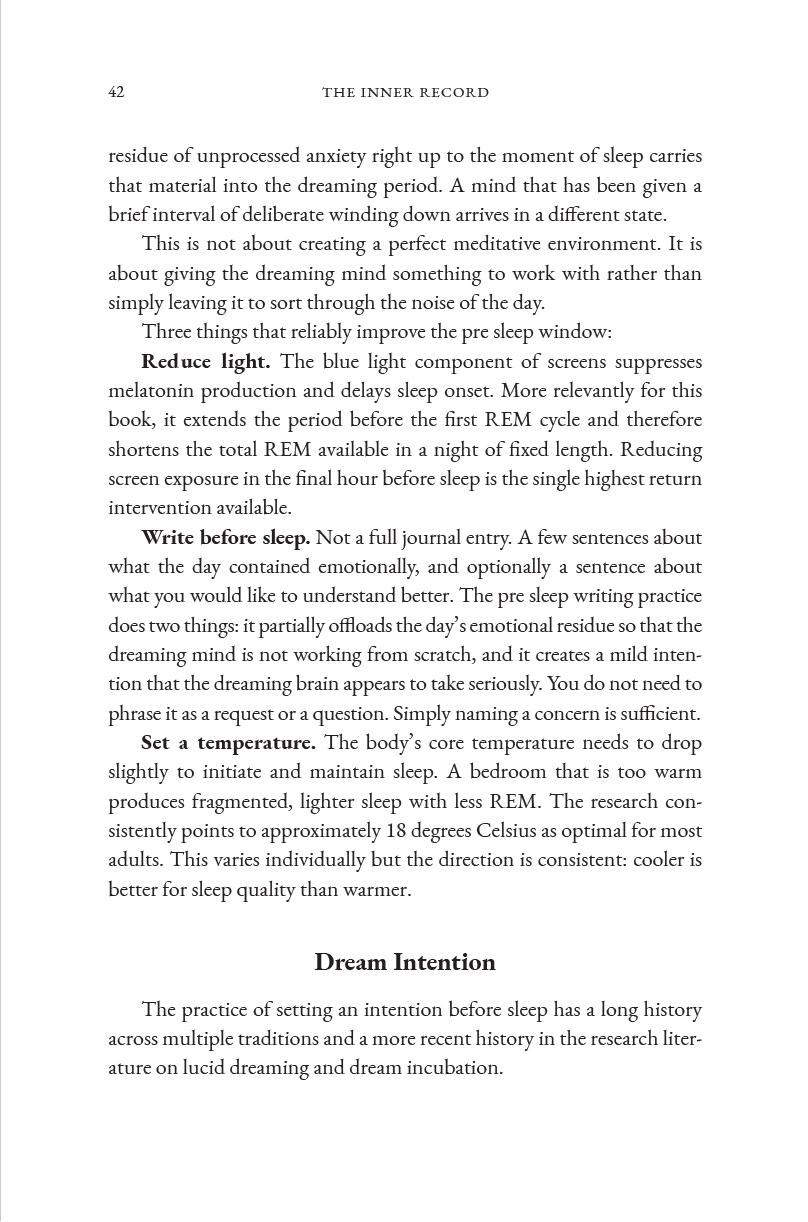
The thirty minutes before you fall asleep are more significant than most people treat them. The dreaming brain does not switch on at a fixed point after you close your eyes. It is influenced by the state you bring to sleep. A mind that has been exposed to screens, arguments, or the residue of unprocessed anxiety right up to the moment of sleep carries that material into the dreaming period. A mind given a brief interval of deliberate winding down arrives in a different state.
Three things reliably improve the pre-sleep window:
Reduce light. The blue light component of screens suppresses melatonin and delays sleep onset. More relevantly for this book, it extends the period before the first REM cycle and therefore shortens the total REM available in a night of fixed length. Reducing screen exposure in the final hour before sleep is the single highest return intervention available.
Write before sleep. Not a full journal entry. A few sentences about what the day contained emotionally, and optionally a sentence about what you would like to understand better. This partially offloads the day's emotional residue so the dreaming mind is not working from scratch, and it creates a mild intention that the dreaming brain appears to take seriously. Simply naming a concern is sufficient.
Set a temperature. The body's core temperature needs to drop slightly to initiate and maintain sleep. A bedroom that is too warm produces fragmented, lighter sleep with less REM. The direction is consistent: cooler is better for sleep quality than warmer.
Exactly as they appear in the paperback. Tap any page to view it full size.